
ISL Postdoctoral Scholar Publishes Study on Physical Activity and Cognitive Health in Older Adults
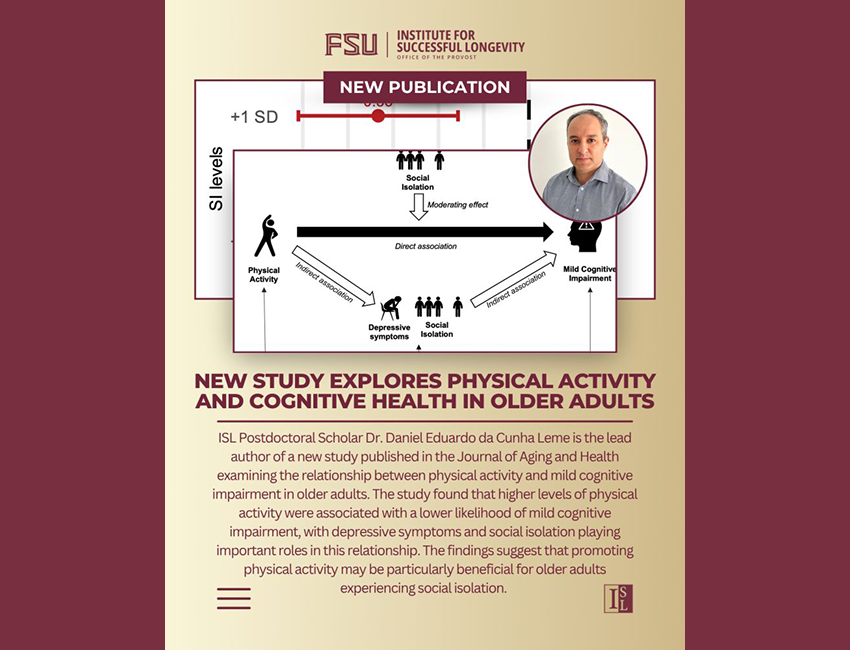
Physical Activity May Support Cognitive Health Through Both Physical and Psychosocial Pathways
New study led by ISL postdoctoral scholar Daniel Leme examines how physical activity, depression, and social isolation are connected to cognitive health in older adults
A new study led by Daniel Eduardo da Cunha Leme, Ph.D., postdoctoral scholar at Florida State University’s Institute for Successful Longevity (ISL), provides new insights into how physical activity may be associated with cognitive health among older adults—and how social and psychological factors may shape that relationship.
Published in the Journal of Aging and Health, the study, “Psychosocial Pathways Between Physical Activity and Mild Cognitive Impairment in Community-Dwelling Older Adults: Mediation and Moderation Analyses,” examined the relationships among physical activity, depressive symptoms, social isolation, and mild cognitive impairment (MCI).
Using nationally representative data from 2,933 U.S. adults aged 60 and older participating in the National Health and Nutrition Examination Survey (NHANES), the researchers found that higher levels of physical activity were associated with a lower likelihood of MCI. The study went beyond examining this direct relationship by investigating the psychosocial pathways that may connect physical activity with cognitive health.
The findings showed that depressive symptoms partially mediated the relationship between physical activity and MCI, suggesting that the connection between staying physically active and cognitive health may involve mental health as well as physical health. The researchers also found that social isolation moderated the relationship between physical activity and MCI.
Notably, the association between greater physical activity and lower MCI was strongest among older adults experiencing higher levels of social isolation. This finding suggests that physical activity may be particularly relevant to cognitive health among older adults who have fewer opportunities for social connection.
"Our findings highlight the importance of looking at cognitive aging from a broader perspective that considers not only physical activity, but also mental health and social connectedness," said Leme. "Programs that create opportunities for older adults to be physically active while also engaging with others may have particular potential for supporting healthy cognitive aging."
The study points to the potential value of community-based programs that combine physical activity and social engagement, particularly for older adults experiencing social isolation. The authors note, however, that because the study used cross-sectional data, the findings represent associations rather than causal effects, and longitudinal and intervention studies will be important next steps.
In addition to Leme, the research team included Mia Liza A. Lustria, Ph.D.; Dawn C. Carr, Ph.D.; Neil Charness, Ph.D.; Kenneth M. Langa, M.D., Ph.D.; and Zhe He, Ph.D. The study was supported in part by the National Institute on Aging and the National Center for Advancing Translational Sciences.
The work reflects ISL’s interdisciplinary mission to advance research that helps people live healthier, more engaged, and more fulfilling lives across the lifespan.
Read the full publication here.