
Institute for Successful Longevity Announces 2026 Planning Grant Winners
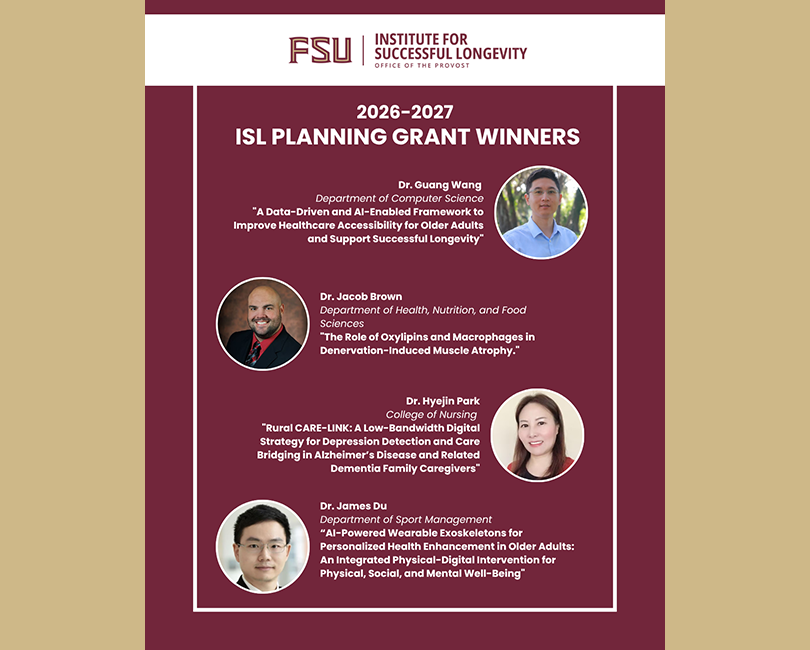
The Florida State University Institute for Successful Longevity (ISL) is pleased to announce the recipients of the 2026–2027 ISL Planning Grant Awards. The ISL Planning Grant Program supports innovative interdisciplinary pilot projects designed to advance healthy aging, successful longevity, and the well-being of older adults while generating preliminary data for future external funding. The Planning Grants provides $25,000 in funding for research in a new direction or continuing support of existing research with the goal of improving the opportunity for successful longevity.
This year’s competition attracted a highly competitive pool of proposals spanning aging biology, artificial intelligence, dementia caregiving, healthcare accessibility, and mobility technologies. Following peer review and committee evaluation, four interdisciplinary projects were selected for funding based on their scientific merit, innovation, feasibility, and strong alignment with ISL’s mission.
2026-2027 ISL Planning Grant Awardees
Dr. Jacob Brown, Department of Health, Nutrition & Food Sciences
Project: The Role of Oxylipins and Macrophages in Denervation-Induced Muscle Atrophy
Dr. Jacob Brown, together with co-investigator Dr. Kislay Parvatiyar, will investigate the biological mechanisms underlying sarcopenia, muscle atrophy, and mobility decline in aging populations. The study focuses on inflammatory lipid signaling molecules known as oxylipins and the role of macrophage-mediated inflammation in denervation-induced muscle loss. By integrating expertise in muscle biology, metabolism, immunology, and aging research, the project aims to identify novel mechanistic pathways contributing to frailty and functional decline in older adults. The work is expected to generate foundational preliminary data to support future NIH/NIA funding focused on sarcopenia and age-related muscle dysfunction.
Dr. Guang Wang, Department of Computer Science
Project: A Data-Driven and AI-Enabled Framework to Improve Healthcare Accessibility for Older Adults and Support Successful Longevity
Dr. Guang Wang will work with Dr. Amber DeJohn in this interdisciplinary project that combines artificial intelligence, geospatial analytics, mobility modeling, and public health research to better understand healthcare accessibility barriers faced by older adults, particularly those living in rural and underserved communities. The research team will develop AI-enabled frameworks to analyze healthcare utilization, transportation accessibility, and geographic disparities that influence aging in place and successful longevity. The project aims to generate data-driven strategies to improve healthcare access and support future NIH, NSF, and transportation-related external funding opportunities.
Dr. Hye Jin Park, College of Nursing
Project: Rural CARE-LINK: A Low-Bandwidth Digital Strategy for Depression Detection and Care Bridging in Alzheimer’s Disease and Related Dementia Family Caregivers
Dr. Hye Jin Park, together with co-investigators Dr. Lucinda Graven and Dr. Qiuchang “Katy” Cao, will develop a low-bandwidth digital tele-care platform designed to support rural caregivers of individuals with Alzheimer’s disease and related dementias (ADRD). Rural family caregivers often face high rates of depression, geographic isolation, limited broadband access, and severe shortages of local mental health resources. Rural CARE-LINK will integrate ultra-brief ecological momentary assessments, symptom-domain mapping, and geographically aware tele-referral strategies to identify caregiver distress and connect caregivers to accessible virtual support services. The project aims to bridge the gap between depression detection and timely care linkage while generating pilot data to support future NIH applications focused on rural health disparities, dementia caregiving, and digital mental health interventions.
Dr. James Du, Department of Sport Management
Project: AI-Powered Wearable Exoskeletons for Personalized Health Enhancement in Older Adults: An Integrated Physical-Digital Intervention for Physical, Social, and Mental Well-Being
Dr. James Du, together with Drs. Hanhan Xue, Amy Kim, Shayok Chakraborty, and Angelina Sutin, will develop and evaluate an AI-assisted wearable physiologic monitoring system to support mobility, physical activity, and functional independence among older adults. The project integrates expertise in aging research, artificial intelligence, wearable sensing, rehabilitation science, and human performance to develop personalized mobility-support technologies for aging populations. The research team aims to establish feasibility and usability data that will support future large-scale external funding focused on aging technologies, rehabilitation, and mobility enhancement.
“These projects reflect the breadth and strength of interdisciplinary aging research at Florida State University,” said Dr. Zhe He, Director of the Institute for Successful Longevity. “The funded projects address critical aging-related challenges through innovative approaches spanning aging biology, artificial intelligence, healthcare accessibility, dementia caregiving, and mobility technologies. We are excited to support these teams as they develop impactful pilot studies that will position them for future external funding and broader translational impact.”
The ISL Planning Grant Program is one of several initiatives through which the Institute for Successful Longevity promotes interdisciplinary collaboration, research innovation, and community engagement related to healthy aging and successful longevity across Florida State University.