
ISL Director Co-Authors Landmark Nature Communications Paper on AI-Powered Clinical Risk Prediction
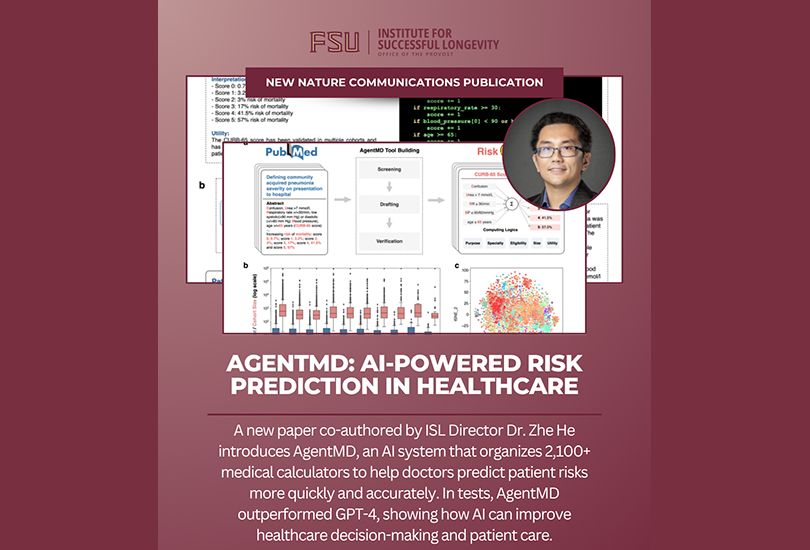
Dr. Zhe He, Director of the Institute for Successful Longevity (ISL) and Professor in the School of Information at Florida State University, has co-authored a major study recently published in Nature Communications titled “AgentMD: Empowering Language Agents for Risk Prediction with Large-Scale Clinical Tool Learning.”
The work, conducted in collaboration with researchers at the National Library of Medicine (NLM), National Institutes of Health, and Yale School of Medicine, introduces AgentMD, an advanced medical language agent that autonomously curates, builds, and applies clinical calculators across thousands of medical contexts. During his 2023–2024 sabbatical at the NLM, Dr. He contributed to the design, data analysis, and evaluation of the system, which represents a breakthrough in applying artificial intelligence to clinical decision support.
AgentMD automatically extracted and verified over 2,100 medical risk calculators from PubMed with over 85% accuracy and a 90% unit-test pass rate. When compared to GPT-4, AgentMD demonstrated dramatically higher accuracy in clinical risk prediction (87.7% vs. 40.9%), effectively computing patient-specific risks from real-world emergency department notes. Beyond individual care, the model also offers insights for population-level risk management across health systems.
“Clinical calculators are indispensable tools in modern medicine, but their use is limited by accessibility and workflow barriers,” said Dr. He. “AgentMD represents a new generation of intelligent language agents that can bridge this gap, learning directly from biomedical literature to provide clinicians with accurate, context-aware risk assessments.”
The study highlights the potential of AI agents integrated with biomedical databases to enhance diagnostic precision, reduce clinician burden, and improve healthcare outcomes. The project’s codebase and datasets, RiskCalcs and RiskQA, are openly available on GitHub, promoting transparency and reproducibility in medical AI research.
This collaboration exemplifies ISL’s ongoing mission to advance AI-driven health informatics and aging research, fostering cross-institutional partnerships that translate computational innovation into real-world healthcare impact.